Stewarding and Combining Reef Monitoring Data
Stewarding and Combining Reef Monitoring Data
The HIMARC ʻOhana includes seven prominent monitoring programs, each using distinct underwater survey methodologies across varying spatial and temporal scales. To bridge these structural differences, datasets from each provider undergo an iterative Quality Assurance and Quality Control (QA/QC) process. This collaborative data governance framework resolves methodological variations and standardizes variables, allowing HIMARC to foster long-term stewardship of the data.
At present, HIMARC has consolidated over 18,000 fish surveys and 11,000 benthic surveys across 25+ years into the HIMARC database, enabling a comprehensive assessment of the condition of coral reefs across Hawaiʻi in our Statewide Reef Indicators.
QA / QC
After receiving data, HIMARC data scientists conduct back-and-forth quality analyses on the data alongside each data provider.
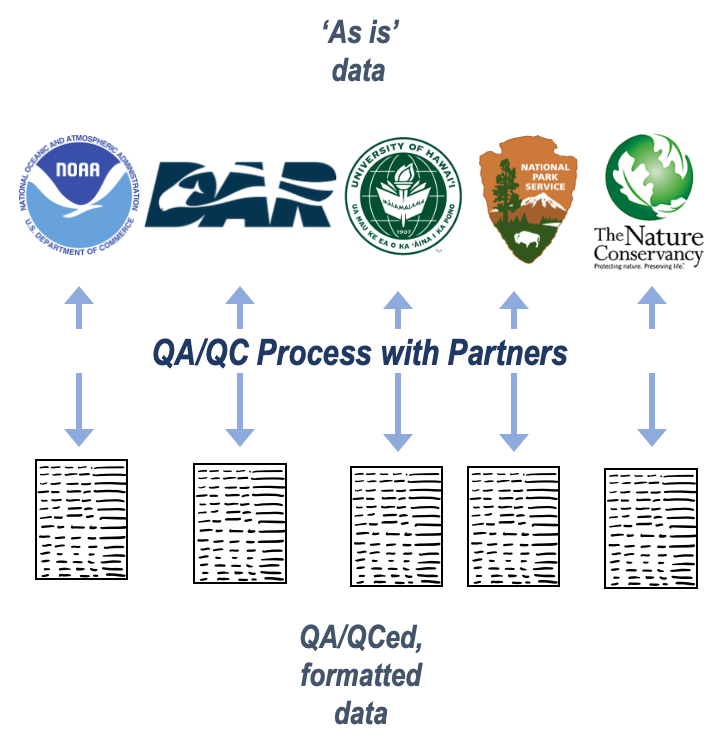
The goals for the HIMARC QA/QC process designed to format and quality control data include:
- Importing a new data file in its original format as received from the data partner.
- Creating traceable line numbers to facilitate tracking and discussion of issues with each data partner.
- Converting the raw dataset into HIMARC’s dataset format.
- Provide our partners with a cleaned-up rendition of their data.
In doing so, HIMARC helps build the capacity for data stewardship across all partners.
After quality analysis, the datasets are aligned and combined for calibration.
Calibrating Fish Surveys
Since HIMARC data providers each use different methods to collect reef indicator data, the datasets need to be calibrated so they can be analyzed together. Data in the HIMARC database are used to estimate a calibration factor between different survey methods. The calibration factor is used to standardize survey counts across the islands so data using different methods can be compared.
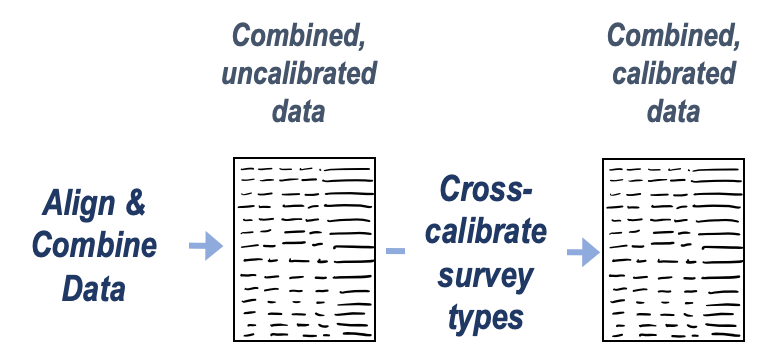
Creating this calibration factor requires HIMARC to design a custom multispecies calibration model. Rather than looking at one species at a time, this statistical framework models hundreds of reef fish species simultaneously across space and time. Our approach allows us to:
- Standardize counts across survey types
- Improve predictions for rarer or rarely seen species by using statistical insights from more common, closely related species.
By applying this model across monitoring partners in the Main Hawaiian Islands, HIMARC converts fragmented monitoring efforts into a unified, comparable dataset to support Place-based Monitoring & Reporting and Tailored Analyses.
The Calibration Team is led by Dr. Megan Donahue (University of Hawai‘i) and Dr. Jake Ferguson (University of Kentucky) with assistance from Dr. Laura Jimenez (Center for Wildlife Studies) and Dr. Mary Donovan (University of Hawai‘i).
For transparency and reproducibility, high-level data summaries associated with our peer-reviewed publications are permanently archived on Zenodo or GitHub. Detailed regional datasets remain under the stewardship of our individual partners; inquiries and specific data requests should be directed to the respective originating organization.